
In ion chromatography, isocratic elution uses a constant mobile phase composition so retention depends only on analyte–stationary phase affinity, offering simple validation and fast routine runs for narrow retention windows. Gradient elution varies eluent strength over time to compress retention Anion analysis, improve peak shape, and resolve complex or broadly distributed analytes, but demands precise pumps, equilibration, and careful temperature control. The choice balances resolution, sensitivity, run time, and reproducibility; further explanation covers optimization and pitfalls.

Basics of Isocratic Elution and How It Works
Isocratic elution in ion chromatography maintains a constant mobile phase composition throughout the run, delivering a steady eluent strength that governs analyte retention times. The technique uses constant flow and fixed solvent strength to produce reproducible retention behavior across injections. Under isocratic conditions, retention is determined by analyte affinity for stationary phase versus the unvarying mobile phase, enabling straightforward calculation of capacity factors and selectivity https://laballiance.com.my/. Instrumental setup emphasizes stable pump delivery, degassed mobile phases, and column equilibration to prevent drift. Isocratic operation simplifies method validation, supports rapid routine analyses for narrow retention windows, and reduces solvent programming complexity. Limitations include long elution times for strongly retained species and diminished control over peak focusing compared with dynamic approaches.
Principles of Gradient Elution in Ion Chromatography
In gradient elution, the mobile phase composition is varied systematically during a run to change eluent strength and thereby modulate analyte retention. The principle relies on controlled alteration of ionic strength or organic modifier concentration to shift equilibrium between analyte, stationary phase, and eluent. A defined gradient profile—linear, step, or segmented—dictates retention time compression, peak shape, and resolution for a range of analyte affinities. Column temperature interacts with the gradient to influence kinetics and selectivity; stable temperature control guarantees reproducible retention shifts. Precise pump and mixer performance are required to reproduce programmed gradients and avoid artifacts. Method development prioritizes gradient slope, initial and final composition, and re-equilibration to balance throughput, sensitivity, and chromatographic freedom.
Choosing Between Isocratic and Gradient: Sample Considerations
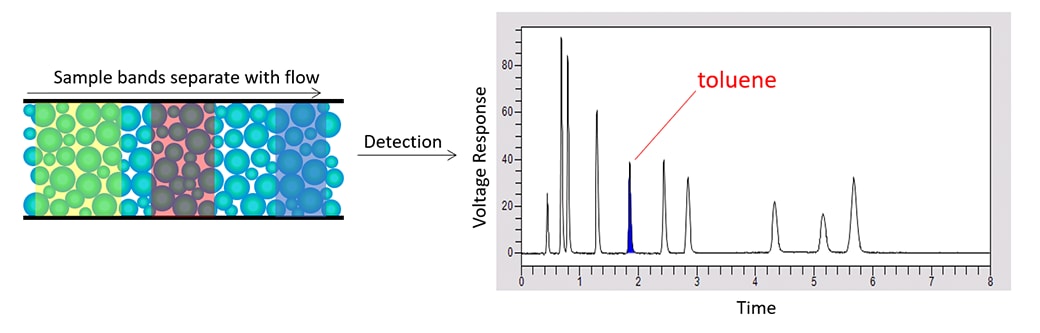
Having outlined how gradient profiles modulate retention and peak behavior, selection between isocratic and gradient elution should be driven by sample complexity, analyte concentration range, and target resolution. For simple matrices with narrow concentration windows, isocratic runs offer robustness and predictable retention; ionic strength can be held constant to minimize matrix effects. For complex matrices or broad analyte pKa/affinity distributions, gradients permit selective desorption and sharper separation without excessive run length. When trace-level components coexist with major ions, gradient programming can reduce coelution and detector overload while managing baseline shifts from ionic strength changes. Sample cleanup, expected interference patterns, and the need to control matrix effects determine whether the added method development of gradients is justified over isocratic simplicity.
Practical Trade-offs: Sensitivity, Resolution, Run Time, and Reproducibility
Although method choices often aim to optimize a single metric, practical ion chromatography requires balancing sensitivity, resolution, run time, and reproducibility because improvements in one area commonly degrade another. The analyst evaluates detector sensitivity against peak capacity: longer gradients or slower flow enhance resolution and sensitivity by widening retention windows, yet increase run time and potential baseline drift. Isocratic protocols can shorten equilibration demands but may compress peaks and reduce resolution for complex matrices. Gradient methods demand rigorous column equilibration to guarantee reproducible retention times and peak shapes between injections; insufficient equilibration undermines precision. Trade-offs also involve loading and dilution effects that affect limit of detection and quantitation. Best selection reflects target analyte priorities, acceptable throughput, and tolerance for variability, not absolute maximization of any single metric.
Method Development Tips and Common Pitfalls
For effective method development in ion chromatography, systematic optimization prioritizes decisive variables—eluent composition, gradient profile, flow rate, column temperature, and sample preparation—while controlling secondary factors such as injection volume and suppressor performance. The practitioner evaluates column conditioning to make certain reproducible retention and baseline stability; improper conditioning yields ghost peaks and drift. Temperature effects must be quantified as they alter selectivity, viscosity, and ion-exchange kinetics; document setpoints and ramping. Adopt a staged approach: screen eluent strength and pH, refine gradient slopes, then optimize flow and temperature. Monitor sensitivity, peak shape, and resolution with representative matrices. Common pitfalls include overfitting gradients to standards, neglecting matrix interactions, inadequate equilibration after changes, and inconsistent suppressor maintenance. Document all parameters to preserve transferability and freedom to adapt.